Everything you need to write about this
Ready-to-paste copy, brand assets and numbers you can check yourself. Nothing here is a claim we cannot back with a file, an address, or a command you can run.
By the numbers
Each of these is checkable without asking us. The how is in the fact sheet.
What it is
BVCC Agent Wallet is an open-source, non-custodial smart wallet built on ERC-4337 and passkeys. It lets you hand an AI agent its own wallet with limits written into the contract: a budget, which tokens it may touch, which protocols it may call, and where it may send funds.
Any MCP client connects in one command and receives 53 tools for transfers, Uniswap swaps, Aave lending and liquidity positions. It runs on five mainnets plus a testnet, and the same wallet address exists on all of them.
The problem
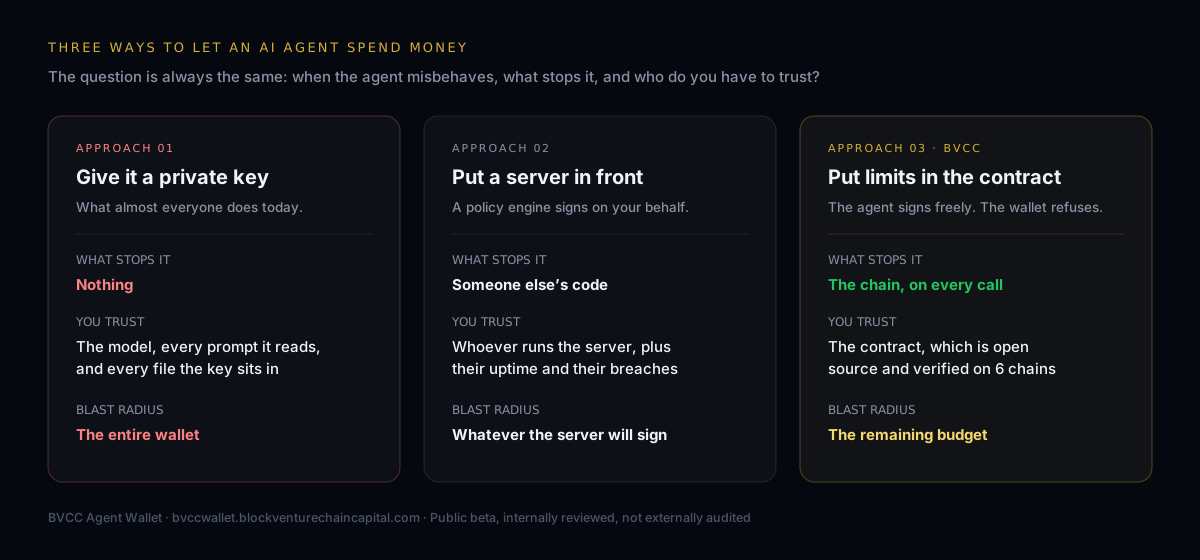
To let an AI agent transact today, you give it a private key. A private key has no ceiling. If the agent is prompt-injected, hallucinates a destination, or the key leaks out of a config file, everything in that wallet is gone, and nothing on-chain was in a position to stop it.
The usual answer is a server in the middle that decides which transactions to sign. That works, and it moves the problem. Now you trust the server, and whoever runs it can sign whatever it likes.
BVCC puts the limits in the contract instead. The agent holds its own key and can sign freely. The wallet refuses anything outside the envelope you set. A leaked agent key is worth its remaining budget, not the account.
What is actually different
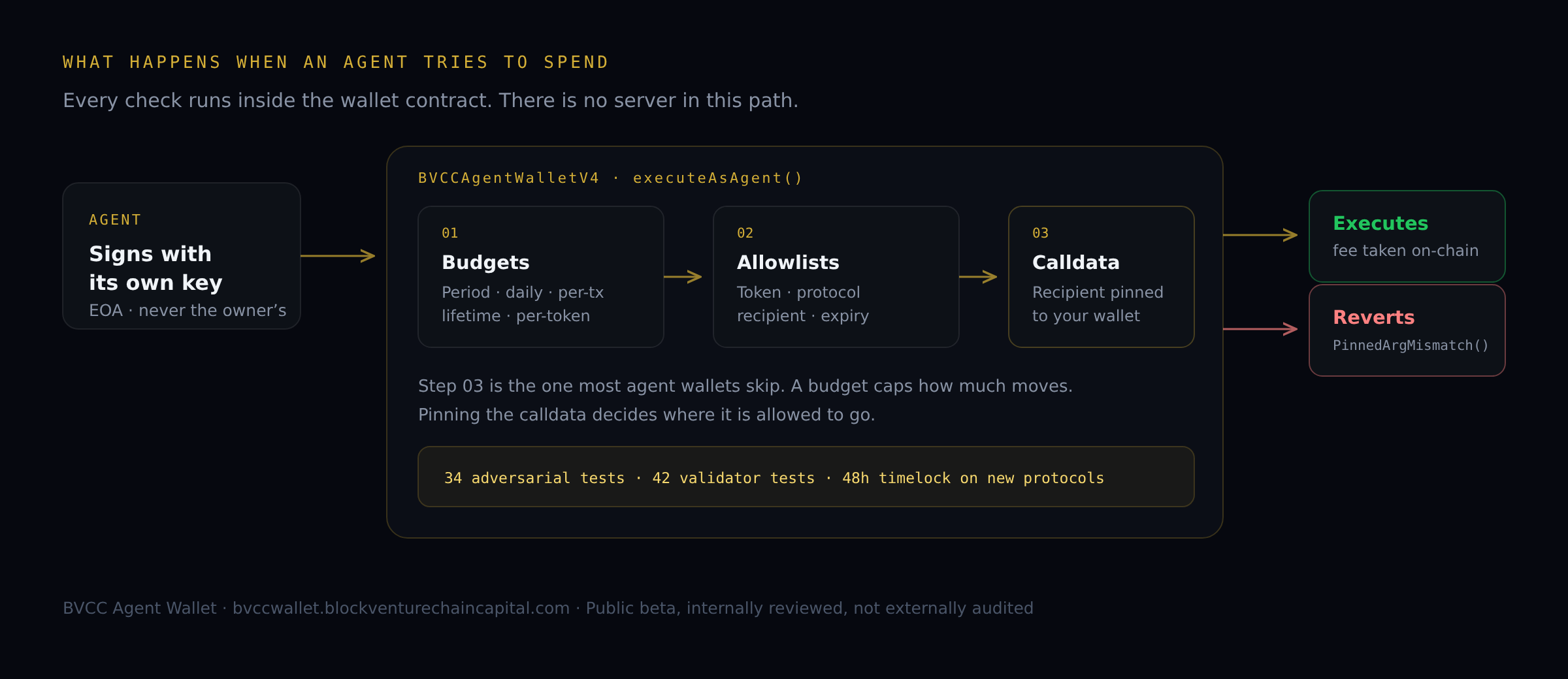
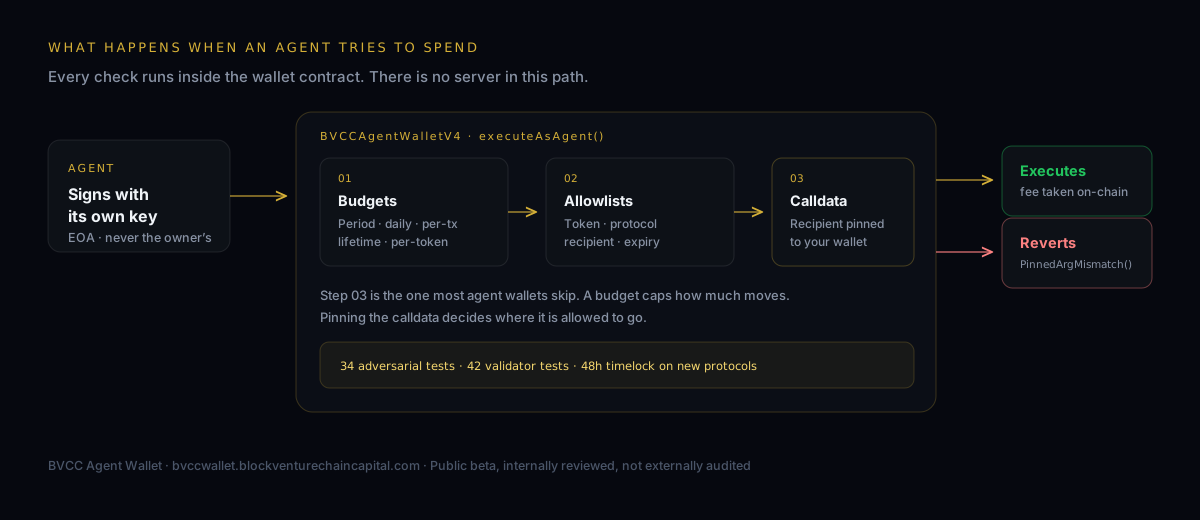
Most work on agent wallets stops at a spending cap. The harder problem is that a cap says nothing about intent. An agent authorized to swap on Uniswap with a $500 budget can route that swap so the output lands in an attacker’s address, and it never goes over $500.
So the wallet inspects the call. For a swap through Uniswap’s Universal Router it pins the recipient argument to your own wallet and matches the command bytes exactly. Anything else reverts with PinnedArgMismatch(). The agent can trade. It cannot trade on someone else’s behalf. There are 34 adversarial tests and 42 validator tests behind that check.
Adding a new protocol to that allowlist goes through a registry with a 48-hour timelock, so the change sits visible on-chain for two days before it can take effect.
What an agent can actually do
Not just swaps. The catalog is 53 tools, and the lending and liquidity halves are the larger part of it.
Supply, borrow, repay, withdraw. Plus four planners that unwind a live position: deleverage, close, swap the collateral, swap the debt — each respecting a health-factor floor and aborting on oracle deviation.
Open a position at a chosen range, collect fees, reduce, close. v4 native ETH pools included, with hooks gated by a registry on a 48-hour timelock.
Uniswap v3 and v4, native ETH in and out, ERC-20 and native sends, approvals.
Most writes have a matching dry-run that returns gas and the revert reason, so a model can check whether something will work before spending anything. Four operating guides it can read first.
A full Aave cycle and a full Uniswap v4 liquidity cycle have both been run end to end on Arbitrum mainnet by an agent, under its limits. Every call still had to pass the contract.
Try it in a terminal
Read-only mode drops every write tool. It can read balances, quote swaps and simulate transactions, and it cannot move anything. Reasonable way to look around before pointing it at real funds.
Drop the flag and the same server exposes all 53 tools. Every one of them still has to pass the contract.
Boilerplate
Written to be pasted straight into an article. Pick the length that fits and copy it.
A non-custodial wallet that gives an AI agent spending limits the contract itself enforces.
BVCC Agent Wallet is an open-source, non-custodial smart wallet built on ERC-4337 and passkeys. It lets you hand an AI agent its own wallet with limits written into the contract: a budget, which tokens it may touch, which protocols it may call, and where it may send funds.
BVCC Agent Wallet is an open-source, non-custodial smart wallet that lets you delegate transactions to an AI agent without handing it a private key that can drain you. You sign in with a passkey. The agent gets its own keypair and a permission envelope enforced by the smart contract: period budget, allowed tokens, allowed protocols, recipient whitelist, expiry, and a pause switch. Any MCP client (Claude, Cursor, LM Studio, Hermes) connects in one command and receives 53 tools for transfers, Uniswap swaps, Aave lending and liquidity positions. It runs on five mainnets. It is in public beta.
BlockVenture Chain Capital is a Web3 brand and project. It is not an incorporated company, a bank, a broker, an exchange, a custodian, or a regulated financial institution. It does not hold, control, or recover user funds.
Founder quote
Every agent framework I looked at solves this off-chain. You run a server, the server decides what to sign, and now the server is the thing that can rob you. I didn’t want to be that server. So the budget and the destination checks live in the contract, where I can’t override them either. If the agent tries to send funds somewhere I never approved, the transaction just reverts. I like that I’m not in the loop.
Founder, BlockVenture Chain Capital
Screenshots
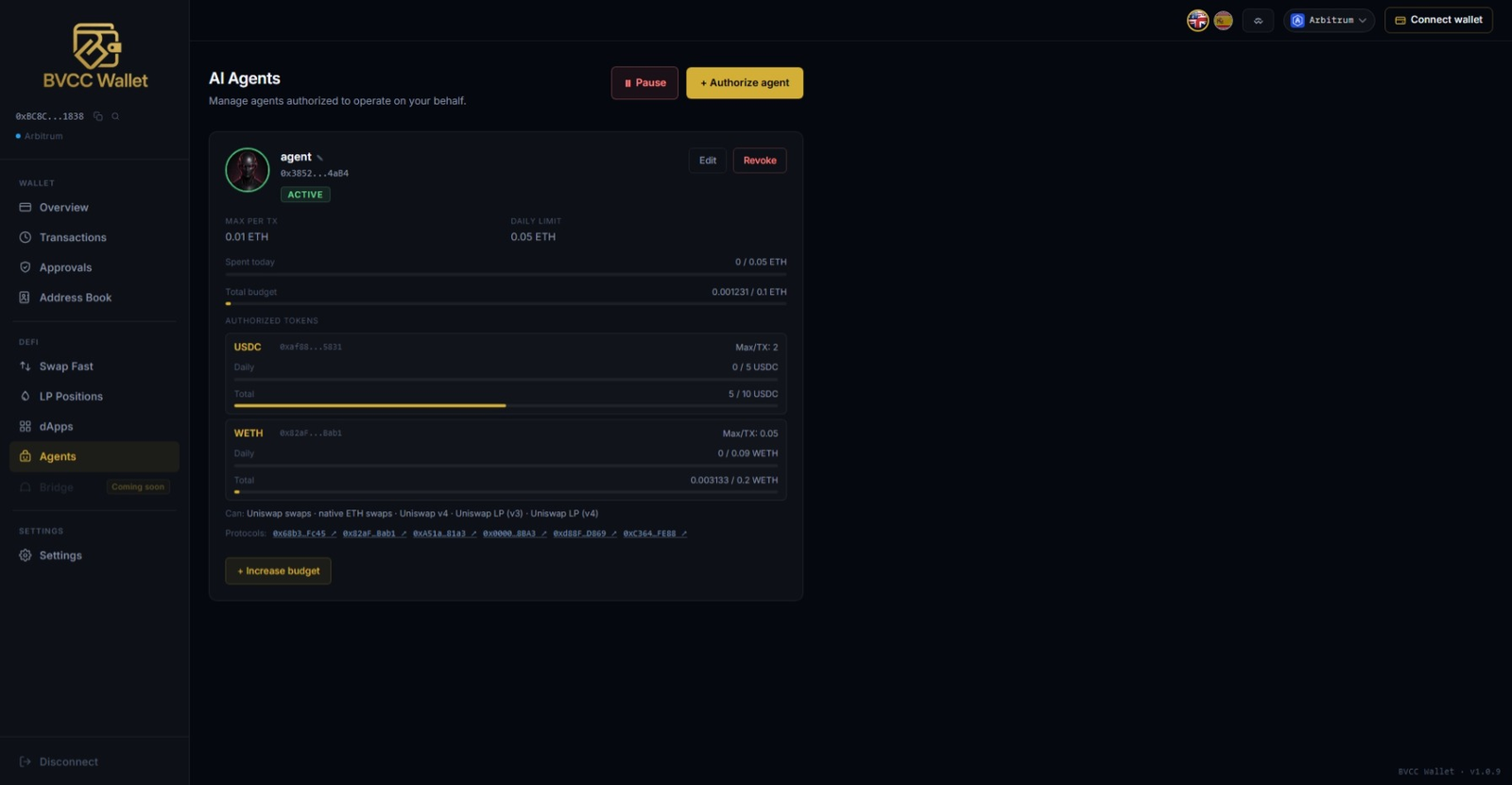 An authorized agent, with its limits and what it has spent Download
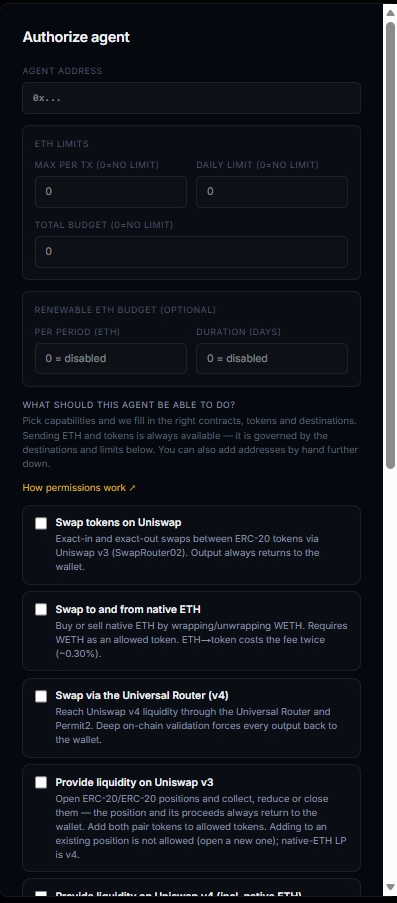 Authorizing an agent — capabilities, not raw addresses Download
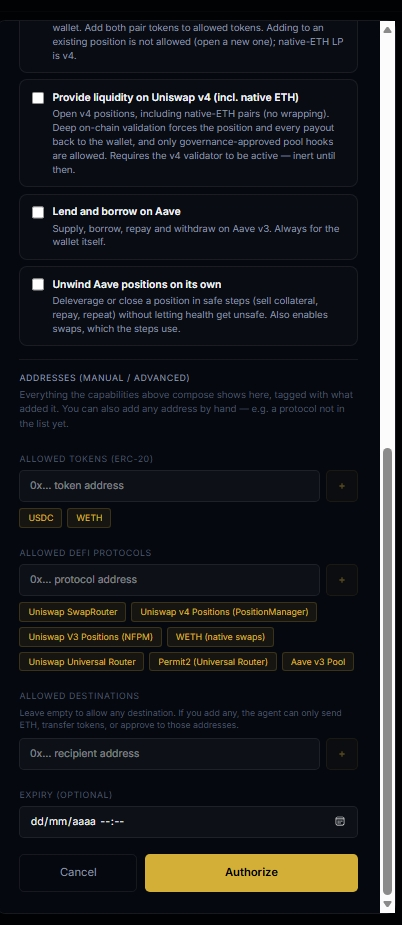 Aave and liquidity capabilities, and the contracts they resolve to Download
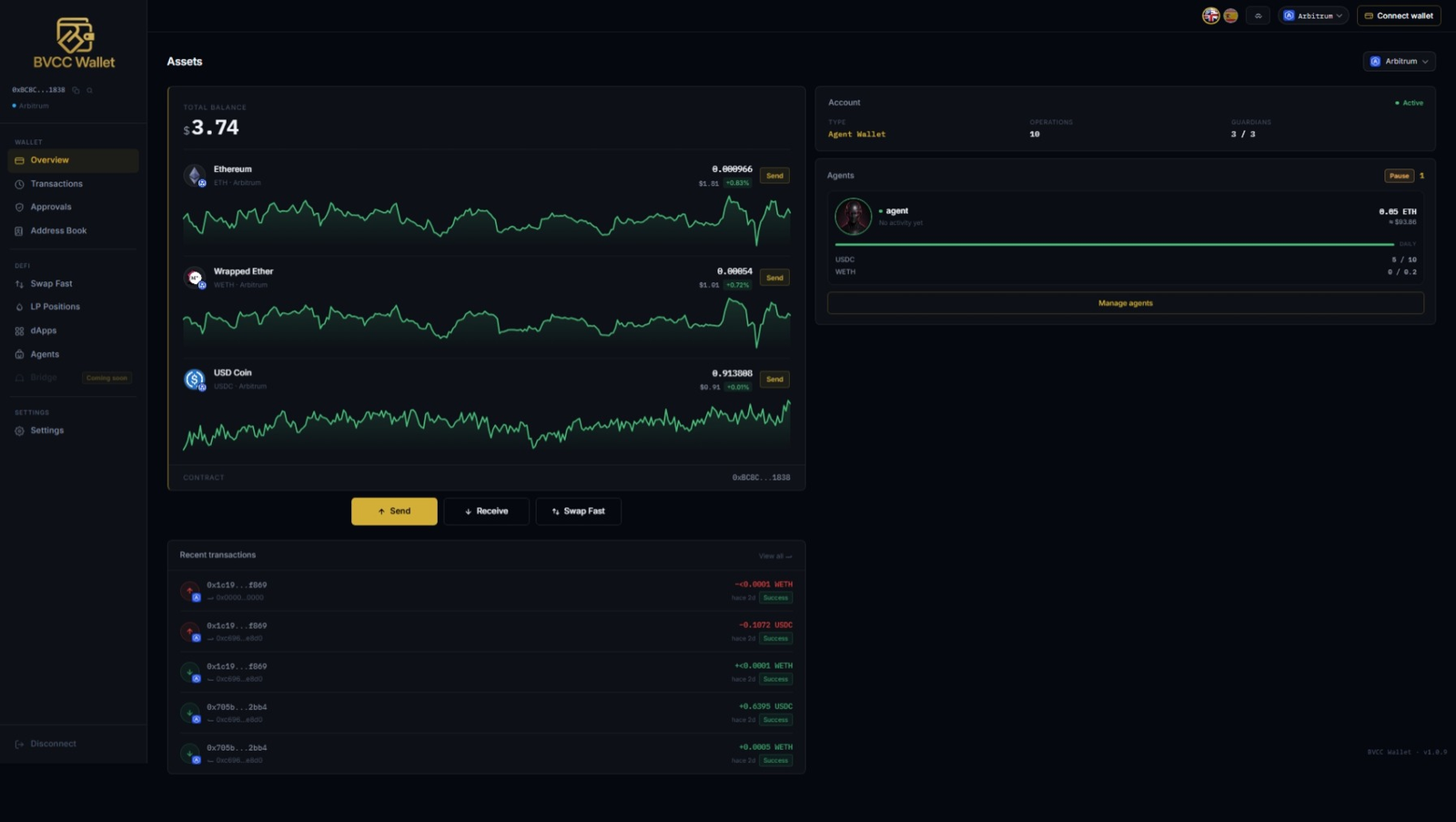 Wallet overview on Arbitrum Download
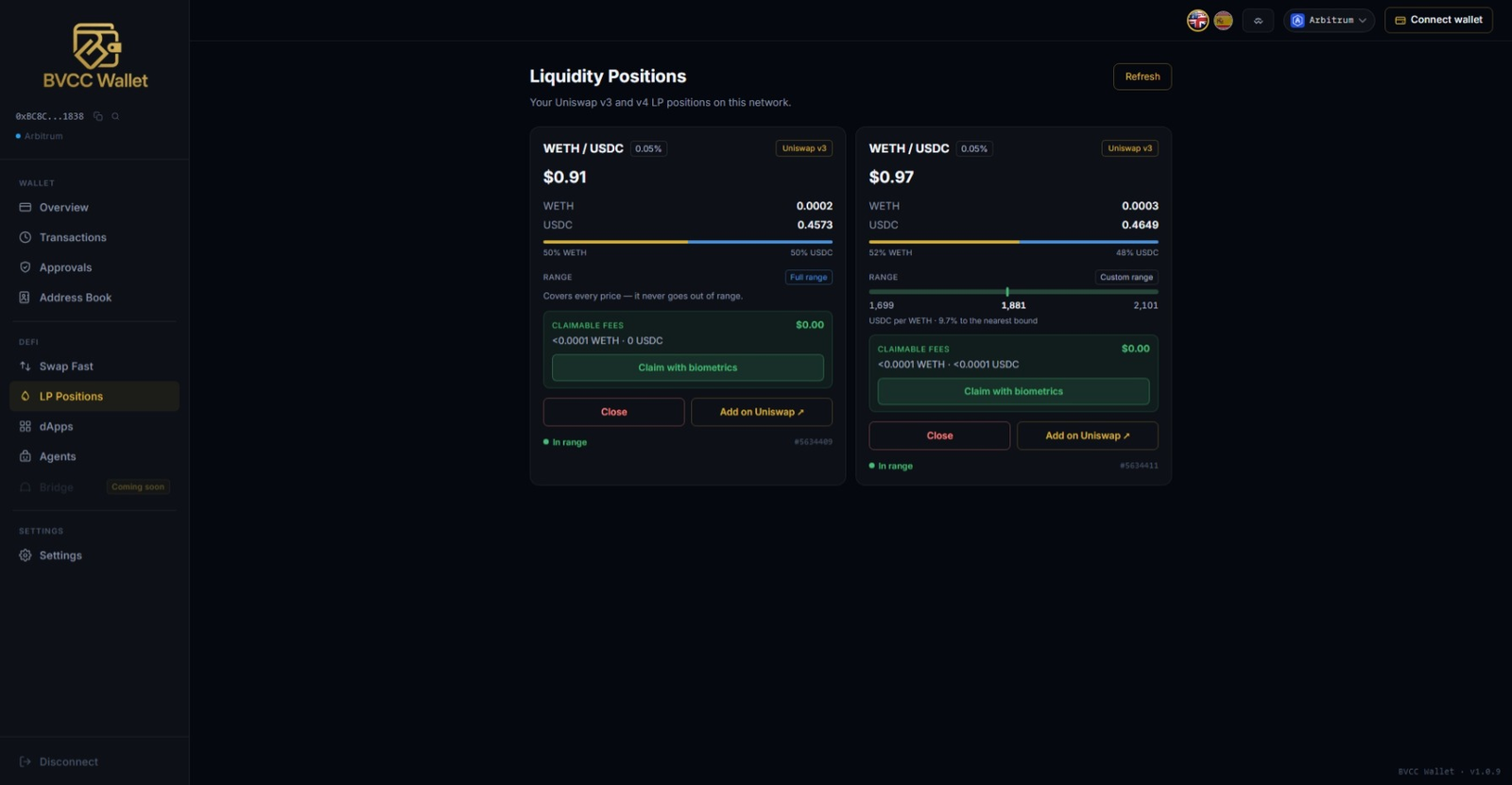 Uniswap v3 and v4 liquidity positions Download
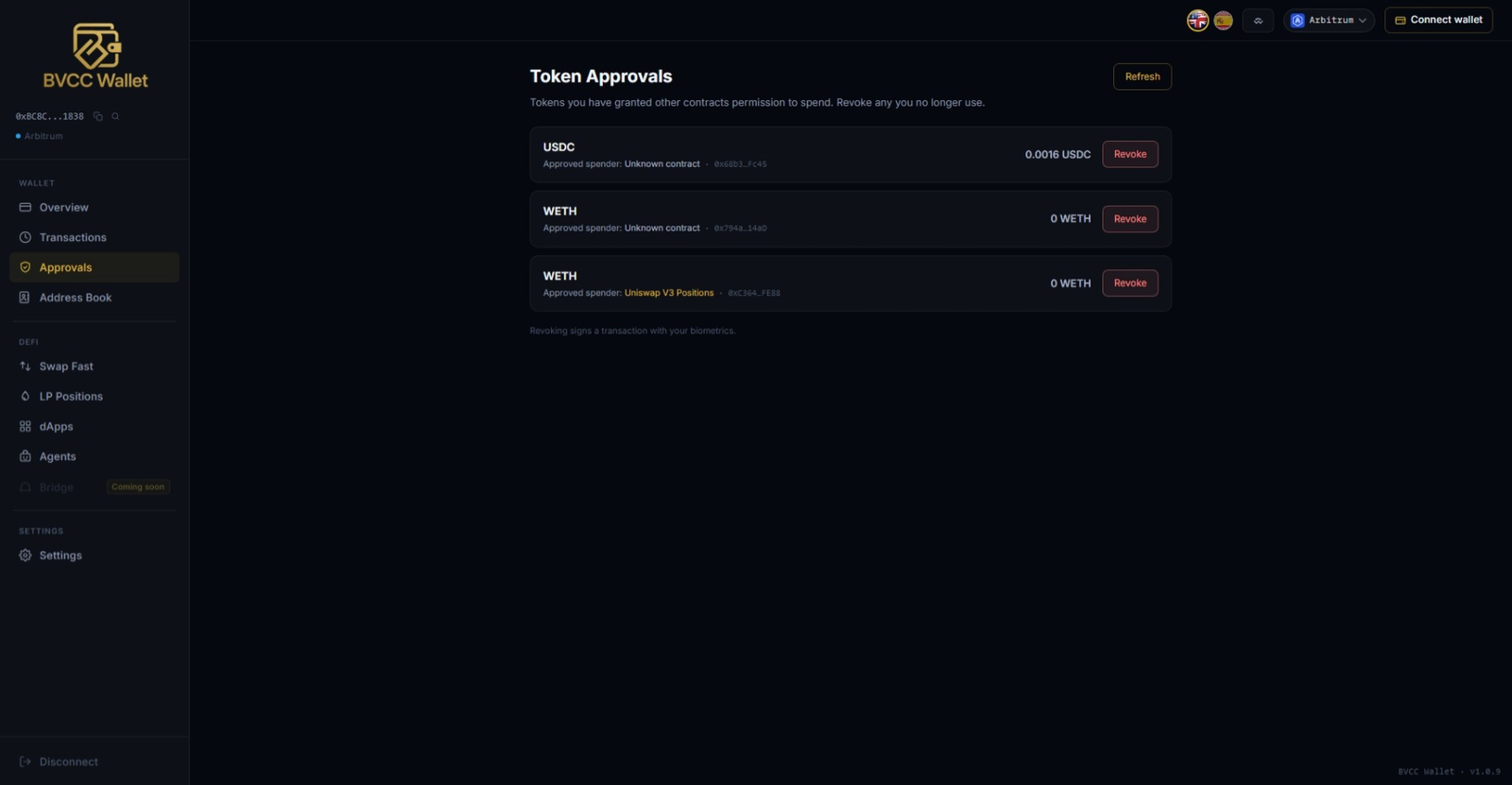 Token approvals, revocable with a passkey Download
Diagrams
Free to use in articles and videos with attribution. SVG and 2x PNG are both in the downloadable kit.
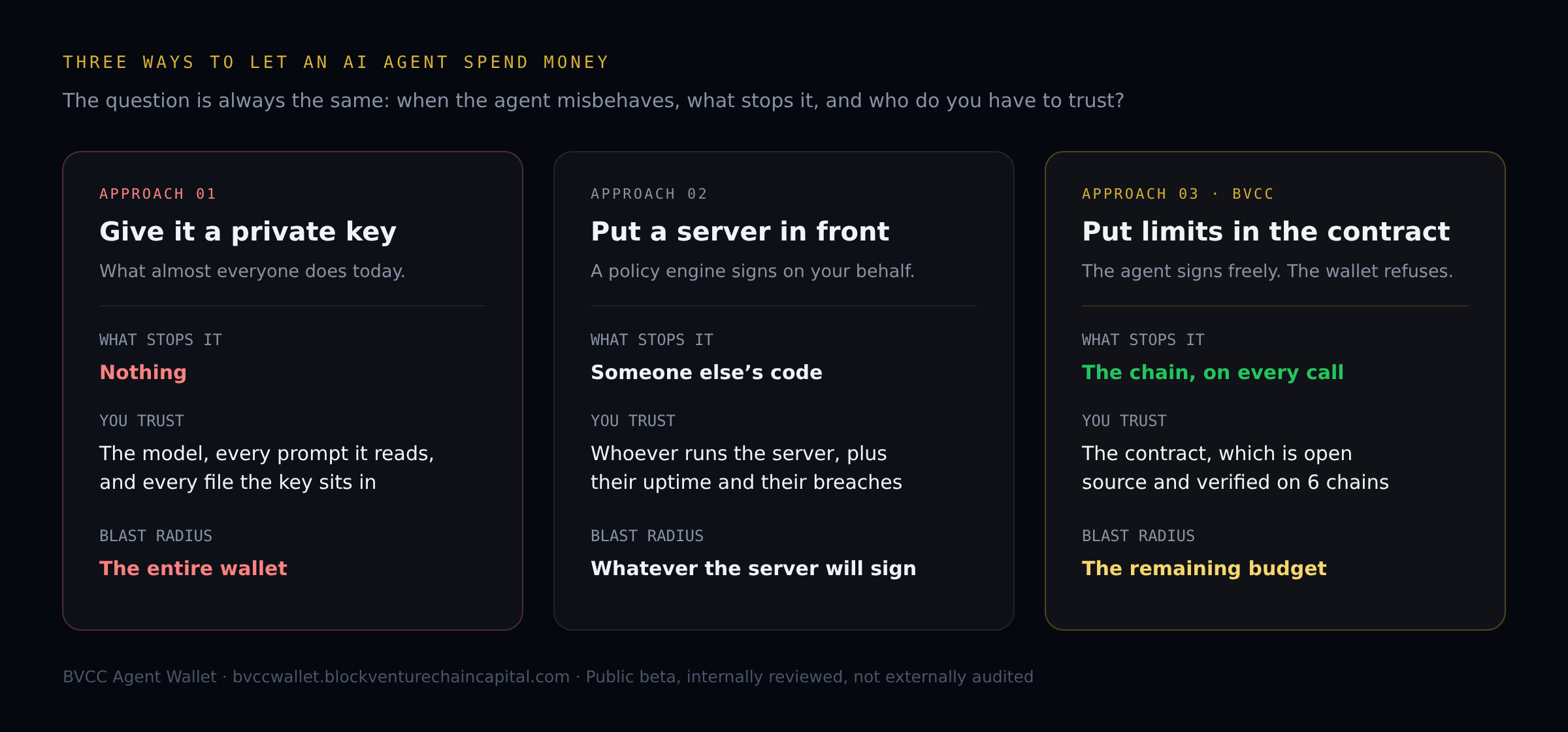
Security, in full
The review is internal, carried out by the developer on his own code. No independent party has audited it, and we would rather you write that than not. The whole findings register is published, including what is still open.
| Critical | 2 | both fixed |
| High | 3 | 2 fixed · 1 open |
| Medium | 5 | 3 fixed · 1 open · 1 accepted |
| Low | 1 | fixed |
| Informational | 2 | 1 mitigated · 1 accepted |
BVCC-03. Where the owner has already granted a token allowance to a protocol, anchoring a call’s destination does not bound its value, so a compromised agent key can be worth more than its budget. The mitigation is to hold zero standing allowances before authorizing an agent that can reach that protocol.
Also worth stating: a deployed wallet cannot be upgraded in place. Wallets still on V1, V2 or V3 run the older bytecode until their owners migrate.
Proof it works on mainnet
All on Arbitrum One, all checkable on the explorer.
Brand
Logo
Use the mark on dark backgrounds. Keep clear space of at least half the mark’s height on every side, do not recolor it, do not add effects, and do not place it on a busy photo. If you need it on light, ask and we will send a version rather than have you invert this one.
Colors
#06080f#0d1117#d4af37#ecc84a#f0f4f8#8892a4#22c55eType
Inter for everything readable, IBM Plex Mono for addresses, code, labels and numbers. Both are open source and on Google Fonts. Monospace is not decoration here: it marks anything a reader might need to copy or verify.
Naming
The product is BVCC Agent Wallet. Not "BVCC wallet", not "the BVCC". On second reference, "the wallet" is fine. The publisher is BlockVenture Chain Capital, shortened to BVCC after first use.
Please avoid these words
Each one would be factually wrong, which is the only reason the list exists.
Fact sheet
The factory addresses are identical on all six networks. That is CREATE2 with a fixed salt, not a coincidence.
Links
Contact
One person answers this address, so expect a real reply rather than a form response. Happy to do interviews, walk through the contracts on a call, or set up a wallet with you so you can watch an agent hit a limit and bounce off it.
[email protected]